
 English
 Français
 Deutsch
 Italiano
 Español
First Time in India: What to Know Before a Himalayan Motorcycle Tour
Straight answers to the fourteen questions every first-time visitor asks us before booking a Himalayan motorcycle expedition — safety, visas, the airport, the road to Manali, altitude, breakdowns and what to pack.
You've seen the videos. The pass at 5,000 metres, the empty road, the prayer flags going sideways in the wind. You want to ride it.
Then the other voice starts up. Is India actually safe? What happens when I land at 2am in Delhi? Can I drink the water? What if the bike dies in the middle of nowhere? What if I get sick at altitude, three days from a hospital?
Those aren't silly questions. They're the right ones. Most tour companies won't answer them properly, though. They'll just tell you it'll be "an adventure" and hope you book anyway.
So here are the real answers. This is written for people flying into India for the first time to ride in the Himalayas — Manali, Leh, Spiti, the high passes. Some of it applies to any trip to India. All of it comes from questions our riders have actually asked us.
1. Is India safe?
Yes, for the kind of trip you're doing, as long as you use the same common sense you'd use anywhere unfamiliar.
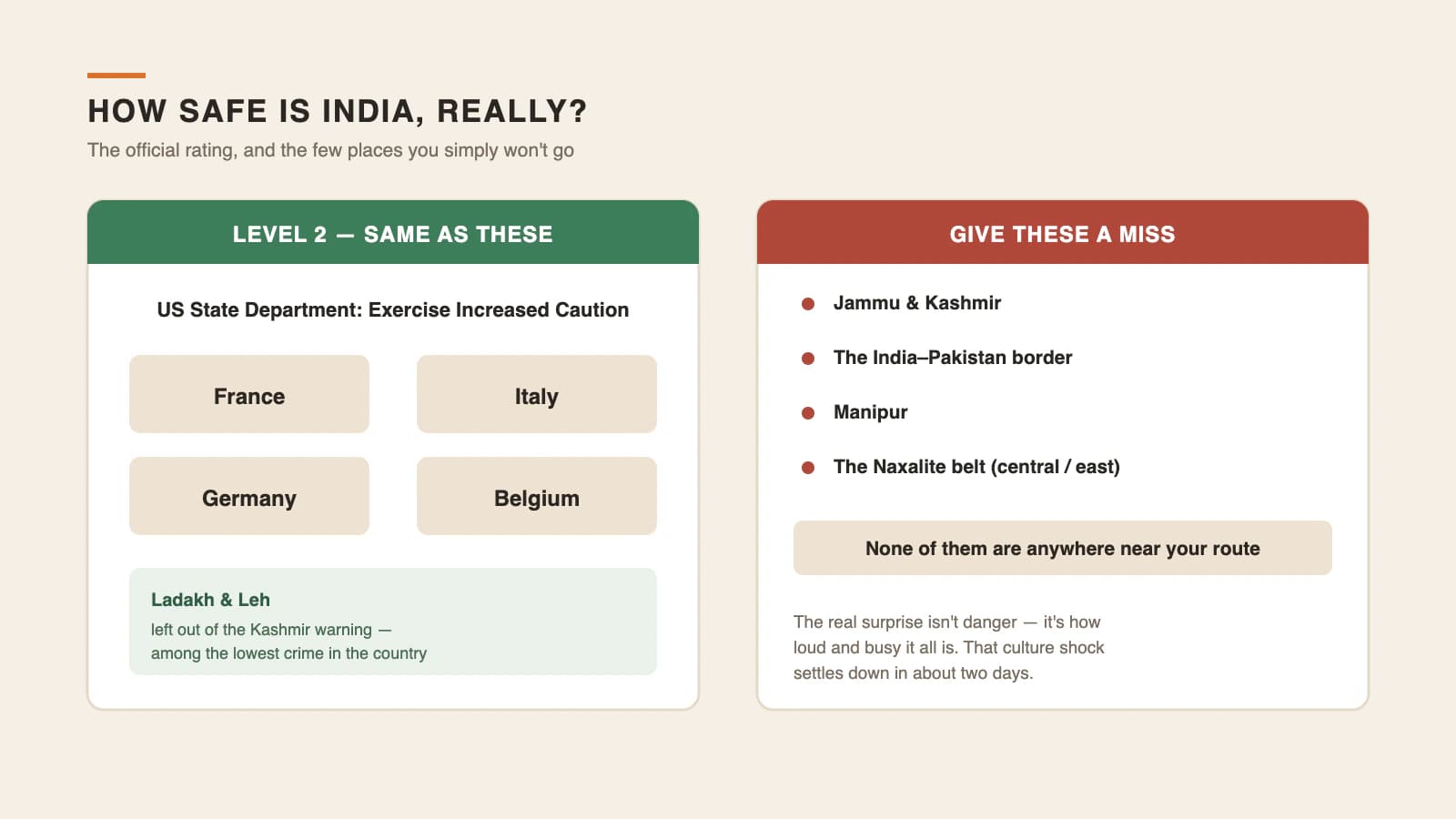
The US State Department rates India Level 2, Exercise Increased Caution. That's the same rating it gives France, Italy, Germany and Belgium. A few regions get stronger warnings: Jammu and Kashmir, the India–Pakistan border, Manipur, and the Naxalite belt in central and east India. You won't go near any of them.
One detail worth knowing: eastern Ladakh and Leh are specifically left out of the Jammu and Kashmir warning. Ladakh has some of the lowest crime in the country. It's a high-altitude Buddhist desert with a small, tight-knit population, and tourism is how most people there earn a living.
What actually catches first-timers off guard isn't danger. It's how loud and busy everything is. The traffic, the crowds, the way every price seems to be a starting offer rather than a price. That's culture shock. It settles down in about two days.
The precautions are the boring ones. Don't flash cash around. Take a prepaid taxi or an app cab from the airport instead of going with whoever walks up to you. Be suspicious of anyone who tells you your hotel has closed or your tour got cancelled and offers to take you somewhere better. That's the oldest trick in Delhi. Women travelling alone should take the same care they'd take in any big city and avoid unfamiliar areas late at night.
On an organised trip most of this never comes up. Someone meets you, someone moves you, and you're with a group.
2. Is Manali safe?
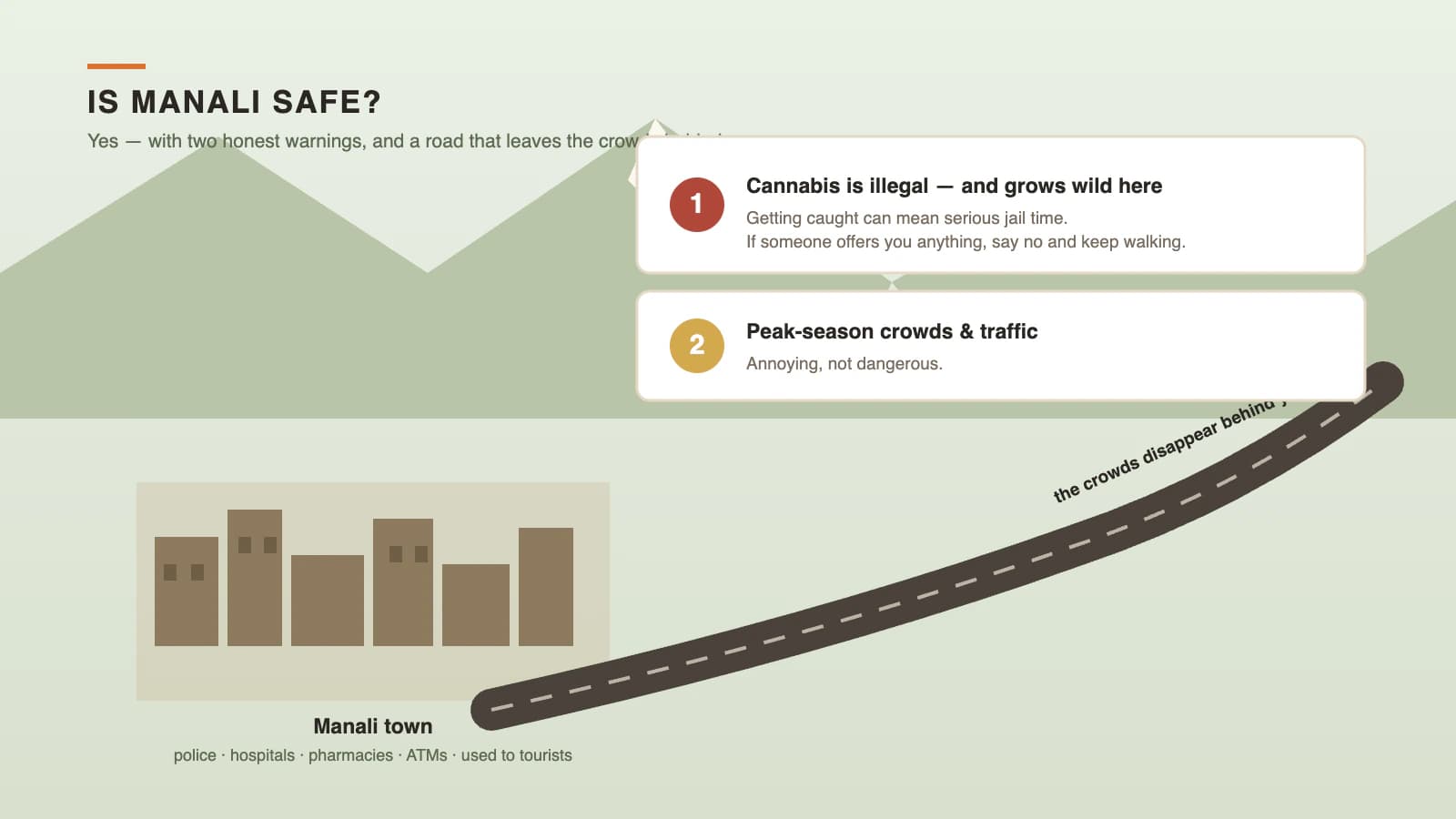
Yes. Manali has been hosting Indian and foreign travellers for decades. Himachal Pradesh has no special warning on it. There's police, hospitals, pharmacies, ATMs, and plenty of people used to dealing with tourists.
Two honest warnings.
Old Manali has a long-running cannabis scene, since the stuff grows wild in the valley. It's illegal. Getting caught can mean serious jail time under India's drug laws, and foreigners don't get let off lightly. If someone offers you anything, say no and keep walking.
The other thing is that Manali in peak season is packed and the traffic is awful. Annoying, not dangerous.
Anyway, the Manali riders remember isn't the town. It's the point a few kilometres up where the road starts climbing and the crowds disappear behind you.
3. What happens at the airport?
You'll almost certainly land at Delhi, Terminal 3. It's big, modern and air-conditioned. Here's how it goes.
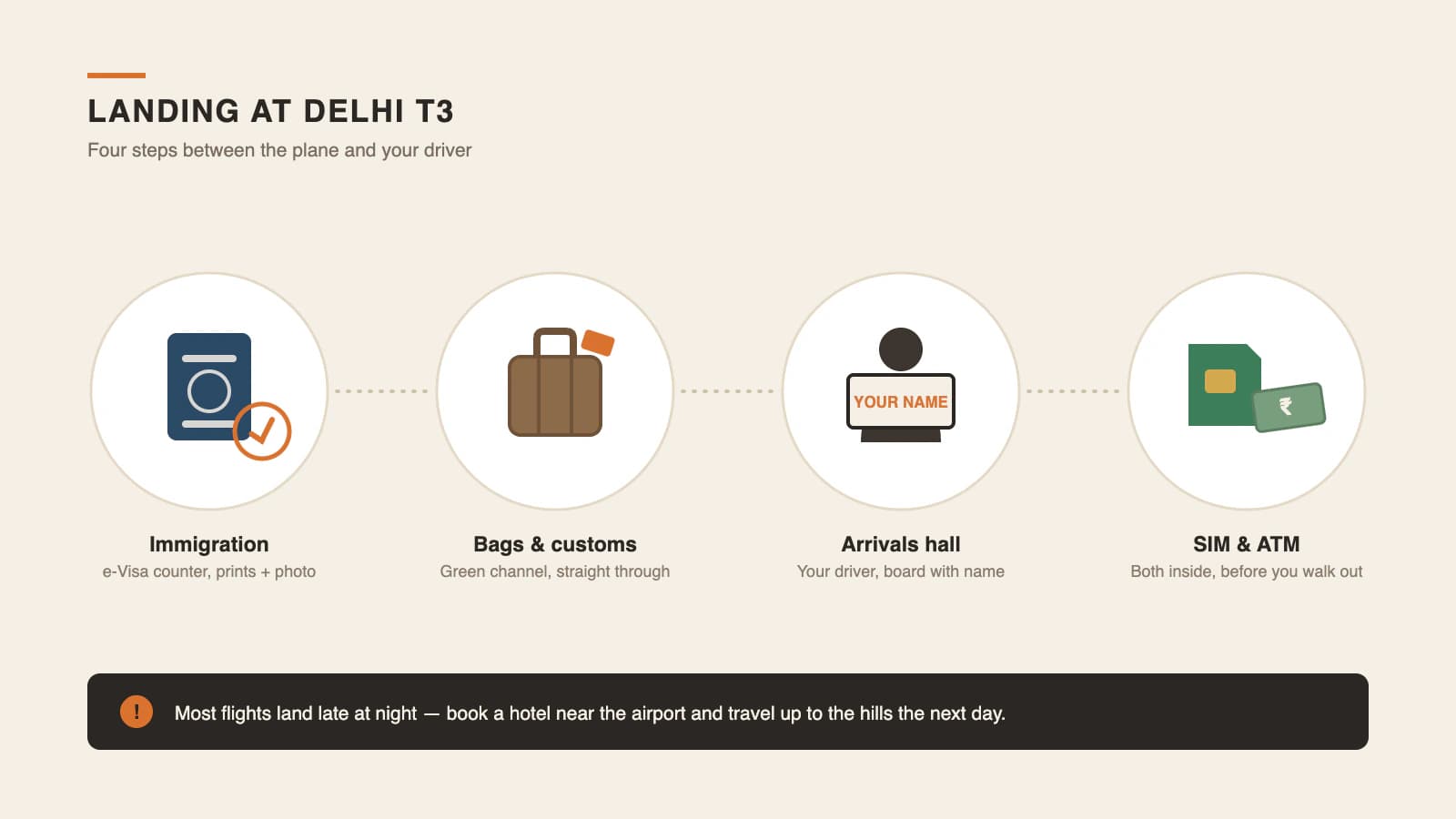
Before you fly, sort out your e-Visa. The official site is indianvisaonline.gov.in, and tourist e-Visas come in 30-day, 1-year and 5-year versions. Apply at least 4 days before you land. The window opens 120 days ahead, and your passport needs at least six months left on it when you apply. Use the government site. Those lookalike sites that charge three times as much aren't scams exactly, but you don't need them.
When you land, you head for immigration. E-Visa holders have their own counter, so look for the signs. They'll take your fingerprints and a photo. At busy times the queue runs 45 minutes to an hour. At 3am it can be ten. Keep your printed visa approval and return ticket where you can reach them.
Then bags, then customs, where you'll most likely walk straight through the green channel and nobody will stop you.
Then the arrivals hall. This is the bit people find overwhelming. It's busy, and there's a wall of drivers holding up name boards. If you're riding with us, yours is in there with your name and our logo, and we send you his photo and phone number the day before. Sorting your own transfer? Use the official prepaid taxi counter inside the terminal, or book an Uber or Ola from the marked app-cab pickup area. Don't go with someone who approaches you in the hall.
ATMs and SIM kiosks are both in the arrivals area, and both are worth using before you walk out. More on each further down.
One thing worth planning for: most long-haul flights land in Delhi late at night or very early morning. If you're moving on the next day, book a hotel near the airport rather than in the city centre. You'll be wrecked, and Delhi traffic is not what you want on day one.
4. How do I get from Delhi to Manali?
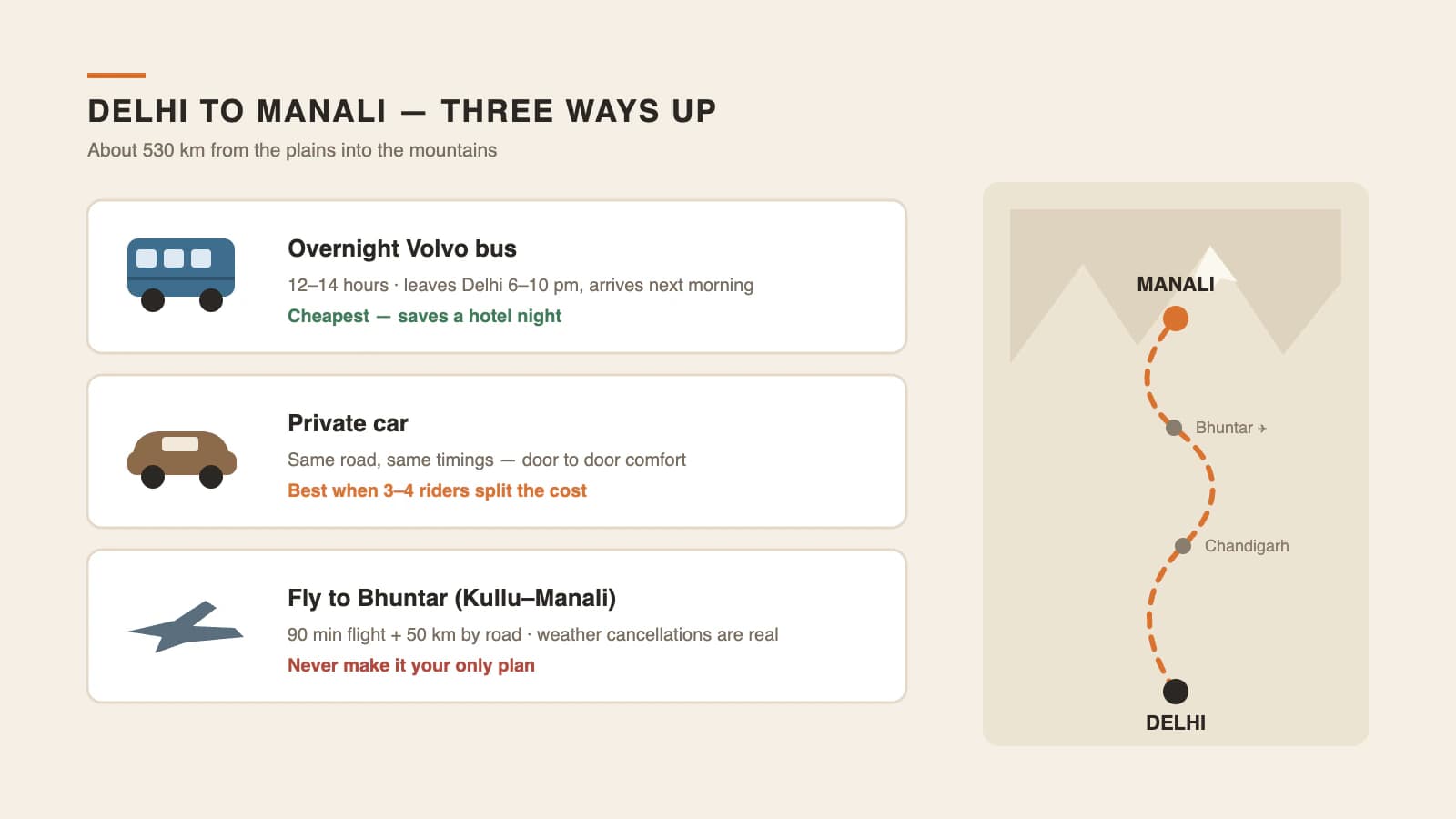
Three ways, and which one suits you depends on your budget and how much holiday you're willing to spend sitting still.
Overnight bus. About 530 km and 12 to 14 hours, depending on traffic and time of year. Volvo AC coaches leave Delhi through the evening, mostly between 6pm and 10pm, and get into Manali the next morning. Prices swing a lot by operator and season, from a few hundred rupees on a basic state bus up to several thousand for a good private sleeper. Book on RedBus, MakeMyTrip or the HRTC site a few days ahead in season.
Private car. Same road, same timings, much more comfortable, much more expensive. Makes sense if there are three or four of you splitting the cost, or if you just can't face a night bus after a long flight.
Flying. Delhi to Bhuntar, the Kullu–Manali airport, takes about 90 minutes, then it's 50 km and another 90 minutes by road. The catch is that Bhuntar is a small mountain airstrip with few flights and a real cancellation rate when the weather turns. Never make it your only plan for getting to a tour start. Flying to Chandigarh and driving the last 300 km is more dependable.
What we'd tell you to do: give yourself a spare day. Land in Delhi, sleep, travel up the next day, and get to Manali with a day in hand before the ride starts. Nearly every problem we see on a Himalayan trip traces back to someone arriving with no margin at all.
5. What about the overnight bus?
Enough people ask about this specifically that it gets its own answer.
It's fine. It's also not a European coach, if that's the picture in your head.
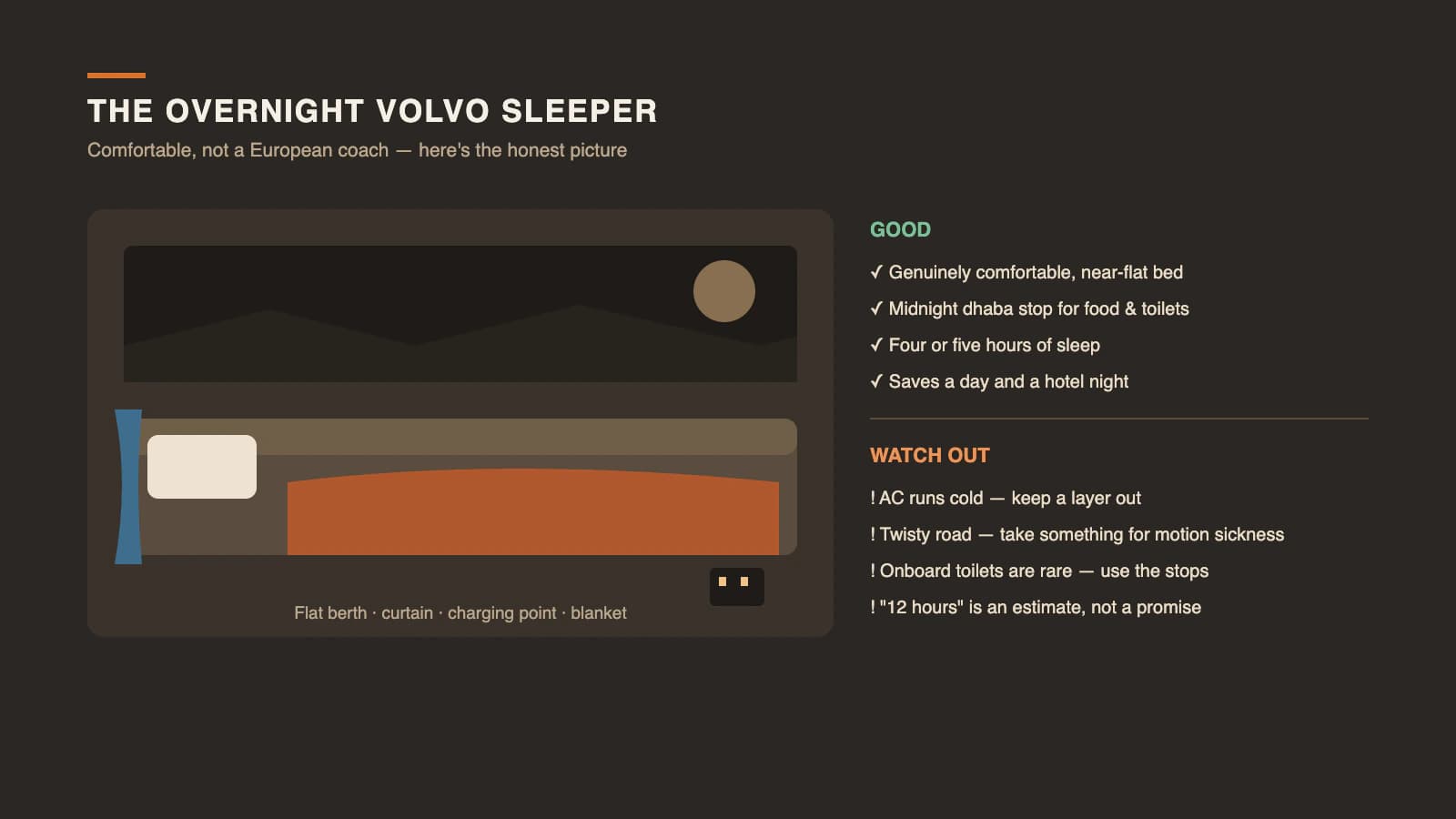
The good version, a Volvo AC sleeper with a proper berth, is genuinely comfortable. Flat or nearly flat bed, a curtain, a charging point, a blanket. The bus pulls into a highway dhaba around midnight for food and toilets. Most people get four or five broken hours of sleep.
Now the less good bits. The road into the hills twists a lot, so take something for motion sickness before you board if you're prone to it. The AC usually runs cold, so keep a layer out. Onboard toilets are rare, which makes the scheduled stops your only chance. And "12 hours" is an estimate, not a promise. A monsoon landslide or a broken-down truck in a tunnel can add several more.
Take it if you're comfortable with long journeys and want to save money and a day. Skip it if you're landing in Delhi that same day. Doing a long-haul flight and a night bus back to back is how riders start an expedition already ruined.
6. Can I drink the water?
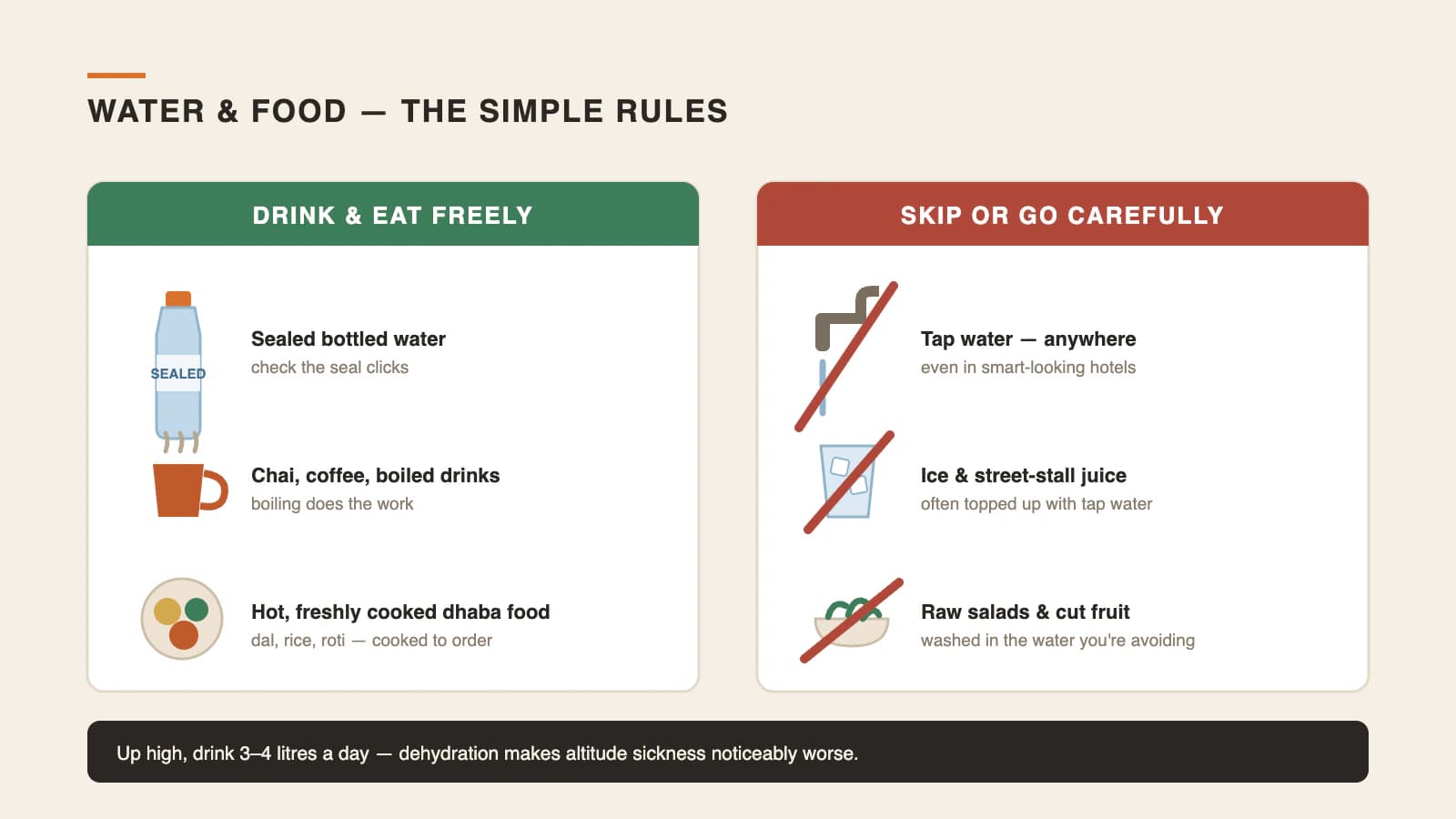
No. Not from the tap, anywhere in India, including in hotels that look expensive.
This isn't a scare story. Water treatment standards are simply different, and it's easy to work around.
Drink sealed bottled water, checking the seal is unbroken, or water you've filtered or treated yourself. We carry bulk water on the road, and most riders bring a filter bottle or purification tablets. That also cuts down the plastic, which matters in somewhere like Spiti where there's nowhere for rubbish to go.
Also fine: tea and coffee, since they're boiled, plus sealed soft drinks and packaged juice.
Go carefully with: ice at smaller roadside places, fresh juice from street stalls, which sometimes gets topped up with tap water, and salads or cut fruit that's been washed in it.
For the first few days, brush your teeth with bottled water and keep your mouth shut in the shower. Small habits, and they stick after a day.
Up high there's a second reason to care. Dehydration makes altitude sickness noticeably worse, and the cold, dry mountain air pulls water out of you far faster than you'd think. On the high sections you want three to four litres a day, which is more than you'll feel like drinking.
7. What food will I get?
Good food, and lots of it.
On a Himalayan trip the day usually looks like this. Breakfast at the hotel, a mix of Indian options like parathas, eggs and poha alongside toast, omelettes, porridge and coffee. Lunch on the road at a dhaba, the roadside truck stops that keep Indian highways running: dal, rice, roti, a vegetable dish, sometimes chicken. Simple, hot, cooked when you order it, and usually excellent. Dinner back at the hotel, normally a buffet or set menu of North Indian and Himachali food.
The higher you go, the simpler it gets. Spiti and upper Ladakh are a long way from anywhere and the growing season is short, so expect plenty of dal, rice, potato, thukpa and momos, and not much fresh veg. That's geography rather than anyone cutting corners.
Vegetarians and vegans have an easier time in India than almost anywhere on earth. A huge share of the population is vegetarian, and "no egg, no dairy" is a request kitchens understand straight away. Tell us when you book and it's handled at every meal.
Coeliac, nut allergies, anything else: tell us at booking, not on day one. Rice-based food makes gluten-free doable, but it needs warning at the remote places, where the kitchen cooks with whatever arrived that week.
If you want it mild, just say so. Indian food isn't uniformly hot, and kitchens will happily tone it down. You do have to ask, though, because their idea of normal might not match yours.
A word on the first few days. Your stomach is meeting a completely new set of bacteria, spices and cooking oils all at once. Ease into it. Skip the Delhi street food on day one however good it smells. Give it a week and then eat everything.

8. What if I get sick?
Some travellers pick up an upset stomach in India. It's common, usually mild, and usually over in a day or two.
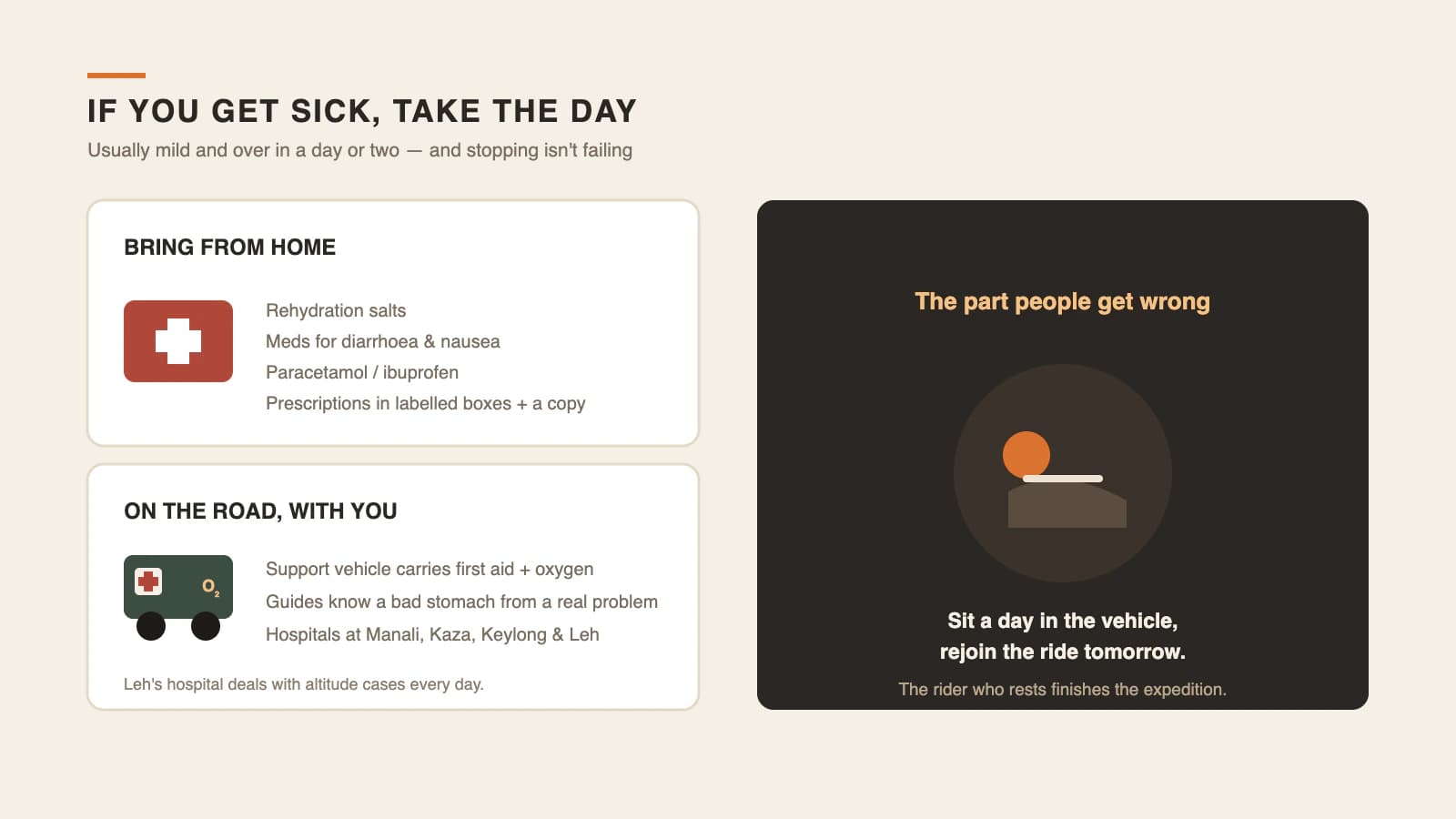
Bring from home: rehydration salts, something for diarrhoea, something for nausea, paracetamol or ibuprofen, and any prescription medicines in their original labelled boxes with a copy of the prescription. Add plasters and blister cover. Talk to a travel clinic or your own doctor well before you fly about vaccinations, and about whether it's worth carrying antibiotics for travellers' diarrhoea. That's a conversation for someone who knows your medical history, not for a website.
On the road, every expedition runs with a support vehicle carrying a first-aid kit and oxygen. Our guides have seen enough to know the difference between a bad stomach and something that needs a doctor. Manali, Kaza, Keylong and Leh all have hospitals or health centres, and the one in Leh deals with altitude cases constantly.
Here's the part people get wrong. If you're properly ill, stop. Don't push through because you paid for the trip. You can sit a day in the support vehicle and rejoin the ride tomorrow, and nobody will make you feel like you've ruined anything. The rider who takes a day off finishes the expedition. The one who rides through a fever at 4,500 metres often doesn't.
Which is also why travel insurance with medical evacuation cover isn't optional. More on that shortly.
9. What happens if my bike breaks?
You get on another one, usually within the hour, and carry on.
This is the biggest worry first-timers bring to us, and the answer is about how the trip is built rather than luck. Every Offhorizon expedition runs with:
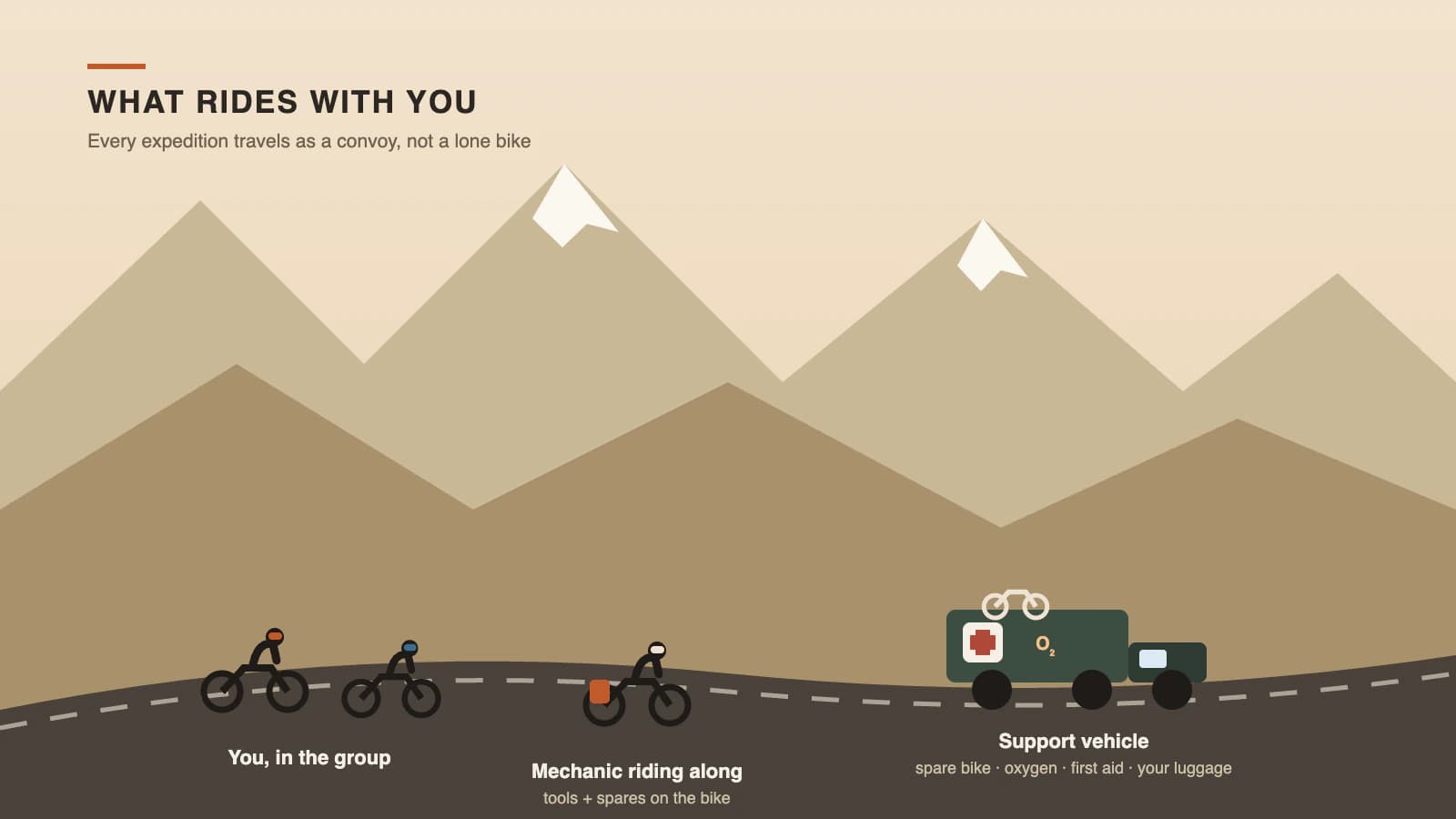
A mechanic riding with the group, not following somewhere behind. He carries tools and spares, and he's fixed everything these bikes can throw at him.
A spare motorcycle travelling with the support vehicle. If yours can't be fixed at the roadside, you take the spare and the broken one goes in the truck.
A support vehicle carrying luggage, fuel, water, oxygen, the medical kit and spares. And you, if you're having a rough day.
We run Royal Enfields, and there's a practical reason for that. Every town in the Himalayas has someone who can work on one. A puncture, a snapped clutch cable, a broken lever, a fouled plug: those are twenty-minute roadside jobs, not trip-enders.
What actually goes wrong out there is punctures, by a long way, then cables, then levers after someone drops the bike at walking pace, and occasionally an electrical gremlin after a water crossing. What basically never happens is a failure that strands you. And if it somehow did, you'd be on the spare.
Riding independently instead of with a company? Then this risk is yours. Out in Spiti or on the Manali–Leh road, "I'll deal with it when it happens" can turn into a very long and very cold wait.
10. What if the road closes?
It happens. Plan around it instead of hoping.
Himalayan roads shut for landslides in the monsoon, snow at the passes early and late in the season, army convoys now and then, and the odd washed-out bridge or stretch of roadworks. Rohtang, Baralacha La, Kunzum La and Taglang La are the usual suspects.
In practice that means a few things.
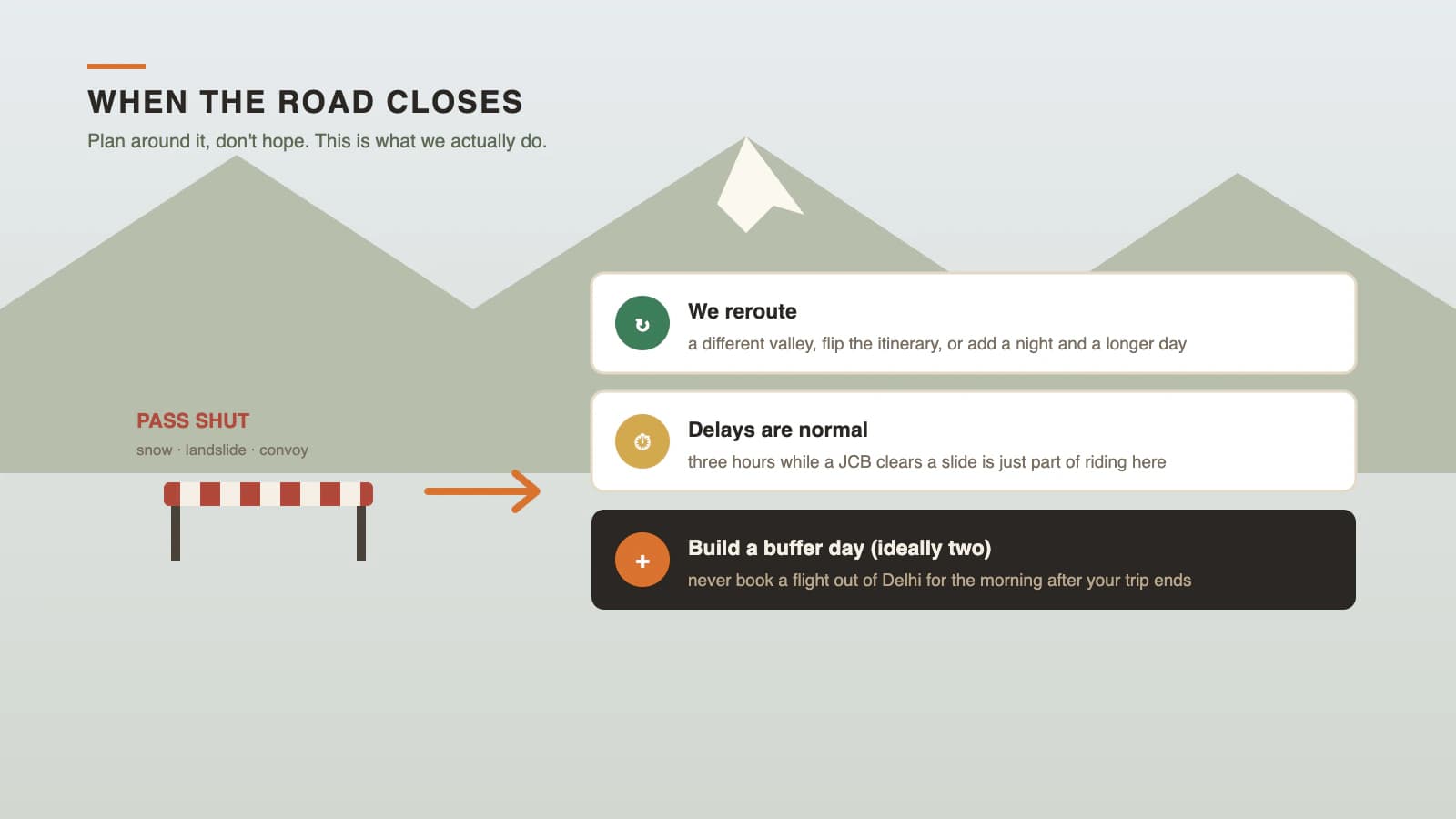
Delays are normal. Sitting for three hours while a JCB clears a slide is part of riding here. It's also, oddly, where some of the best conversations of the trip happen.
Routes get changed. Our guides are on these roads constantly and stay in touch with the BRO, local police and other operators. If a pass is shut we reroute, taking a different valley, flipping the itinerary around, or adding a night somewhere and a longer day after it.
Once in a while the shape of the trip changes. In a bad year a section becomes genuinely impassable and we swap in an alternative. The expedition still runs; the line on the map moves.
And build a buffer. That's the real point. Don't book an international flight out of Delhi for the morning after your trip ends. Leave a spare day, ideally two. Every experienced Himalayan rider does this, and everyone who's had to sprint for a flight out of Leh in bad weather wishes they had.
We say all this upfront because any company promising a guaranteed fixed itinerary in the Himalayas is promising something the mountains never agreed to.
11. What insurance do I need?
Read this bit twice. It's where first-timers get caught out.
You need a policy that clearly covers all four of these:
- 1.
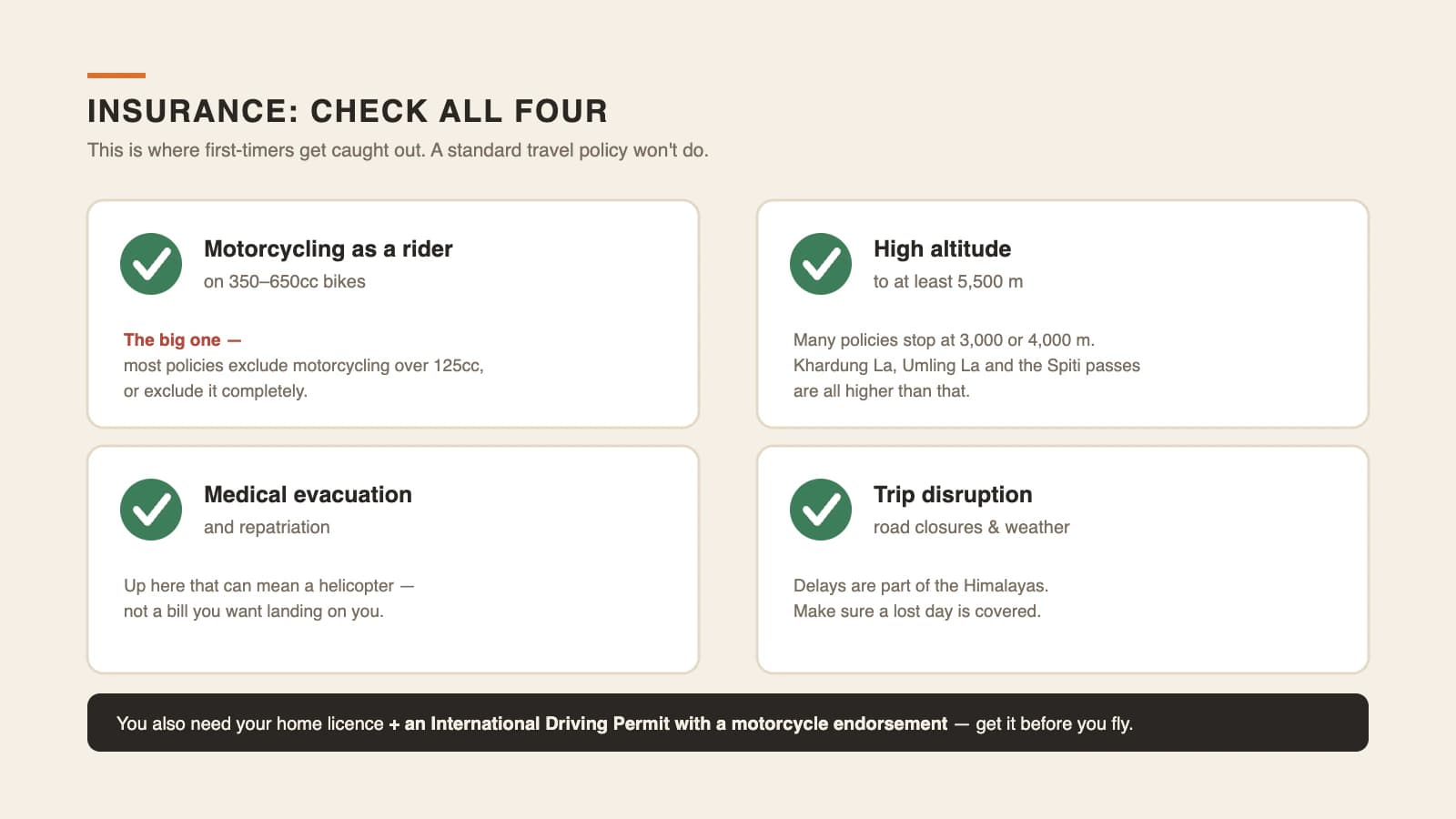
Motorcycling as a rider, on the engine size you'll actually be on. Our Royal Enfields run from 350cc to 650cc. Most standard travel policies exclude motorcycling over 125cc, or exclude it completely. This is the gap that catches the most people.
- 2.
High altitude, up to at least 5,500 metres. Plenty of policies stop covering you at 3,000 or 4,000. Khardung La, Umling La and the Spiti passes are all higher than that, so a 4,000-metre policy stops protecting you around day four.
- 3.
Emergency medical evacuation and repatriation. Up here that can mean a helicopter, and that's not a bill you want landing on you.
- 4.
Trip disruption, for the road closures and weather delays above.
Check too that your cover depends on you holding a valid licence and IDP. Many insurers throw out motorcycle claims if you weren't legally allowed to ride.
On that point: to ride legally in India as a foreigner you need your home motorcycle licence and an International Driving Permit with a motorcycle endorsement. Get it before you fly, because you can't get one once you're here. Your home licence by itself isn't enough, whatever a rental shop in a tourist town might tell you. Helmets are compulsory for rider and pillion.
Riders on our trips commonly use World Nomads, Globelink, Campbell Irvine and DogTag, but policies and exclusions change all the time. Read your own certificate rather than trusting a recommendation, and if any wording is unclear, email the insurer and keep their reply.
We'll ask to see your insurance details and your IDP before the trip starts. That's not paperwork for its own sake. It's because we've seen what happens when someone turns up without them.
12. How much cash should I carry?
Less than you'd think, but never none.
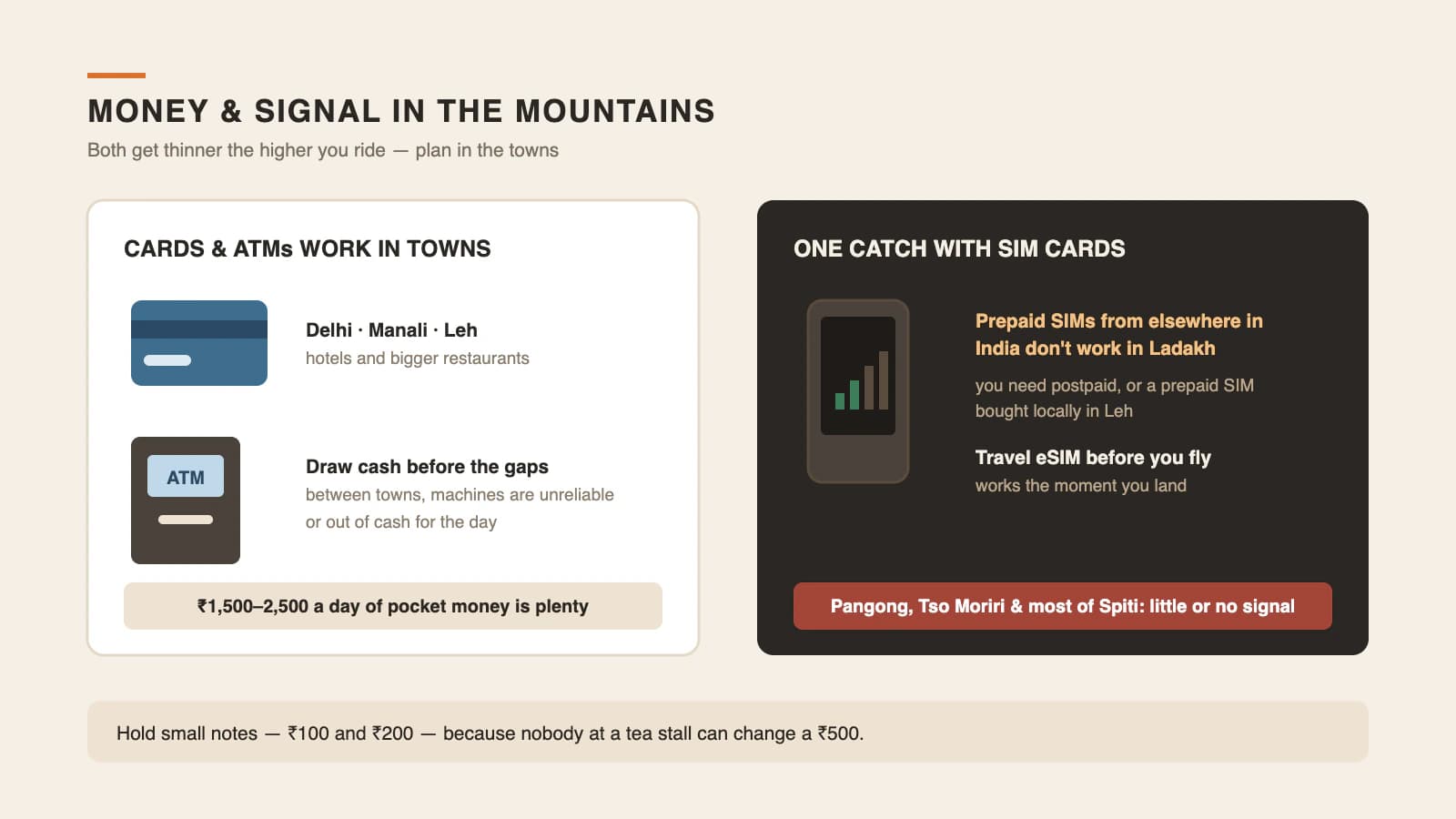
Cards work in Delhi, Manali, Leh, and at most hotels and larger restaurants. UPI, India's instant payment system, is everywhere, but it generally needs an Indian bank account, so as a visitor you'll be using cards and cash.
ATMs exist in Delhi, Manali, Keylong, Kaza and Leh. Between those places, not reliably, and the machine in a small mountain town can be out of cash or off the network for a day. Take money out in the towns, before you're short.
Cash is for dhaba lunches, tea stops, tips, small shops, monastery donations, souvenirs and the occasional village guesthouse with no card machine. On a trip where your rooms and most meals are already paid for, ₹1,500 to ₹2,500 a day of pocket money covers it comfortably.
A few practical things. Tell your bank you're travelling so your card doesn't get blocked on day one. Carry two cards on different networks and keep them in separate places. Hold some small notes, ₹100 and ₹200, because handing over ₹500 at a tea stall often means nobody can change it. Don't exchange much at the airport, where the rates are poor. Take enough for the first day and use ATMs after that. And note that you can't legally carry rupees out of India in any real quantity, so spend down before you fly home.
While we're on practicalities, SIM cards. You can buy a tourist SIM at Delhi airport with your passport and a photo, but activation can take 12 hours or more. A travel eSIM bought before you fly works the moment you land and saves the hassle. One important catch: prepaid SIMs from elsewhere in India don't work in Ladakh. Government rules mean you need a postpaid connection, or a prepaid SIM bought locally in Leh. Either way, expect to be offline up high. Pangong, Tso Moriri and most of Spiti have little or no signal, and honestly that's part of the appeal.
13. What clothes should I bring?
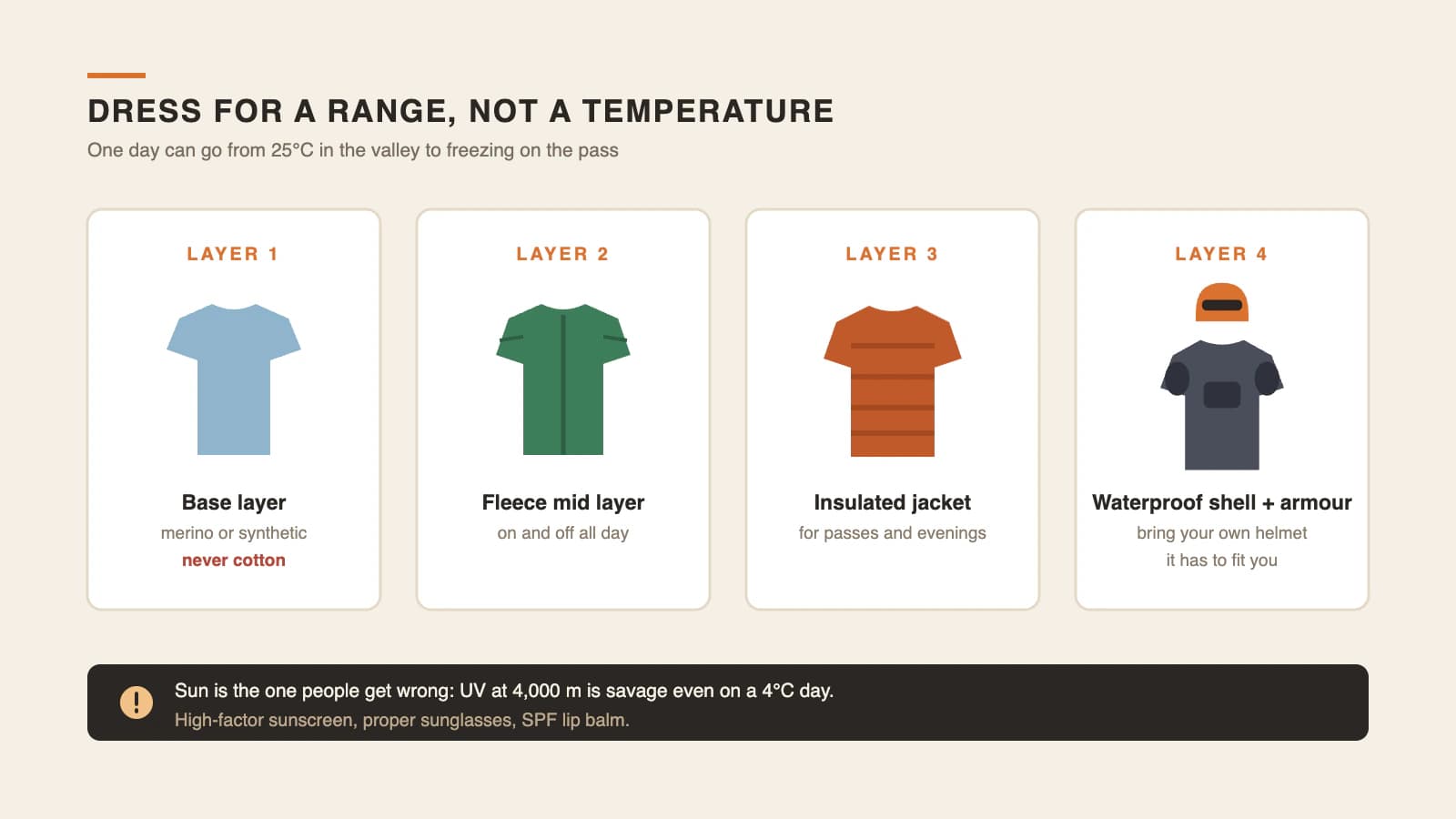
Here's the thing that governs everything else: in a single day you can leave a valley at 25°C and cross a pass at freezing with wind on top. You're not dressing for a temperature. You're dressing for a range.
Layers, not bulk. A base layer in merino or synthetic, never cotton. A fleece mid layer. An insulated jacket. A windproof, waterproof shell. You'll be putting these on and taking them off all day.
Riding gear. Jacket and trousers with armour at shoulders, elbows, knees and back. A full-face or adventure helmet, and bring your own if you can, since it's the one thing that has to fit you properly. Riding gloves plus a warmer pair for the passes. Boots that cover the ankle. Rain gear that actually fits over your riding kit, because it will rain and the spray off the road will find you.
Cold and altitude. Thermal top and bottoms, a warm hat that fits under a helmet, a neck buff or balaclava, warm socks. Even in July the nights in Spiti and Ladakh get close to freezing, and the winter trips are a different game entirely.
Sun. This is the one people get wrong. UV at 4,000 metres is savage, and the cold air hides it completely. High-factor sunscreen, proper sunglasses, lip balm with SPF. Getting sunburnt on a 4°C day is the classic first-timer mistake.
Off the bike. Comfortable trousers and shirts, something warm for the evenings, trainers or sandals, swimwear if your route includes hot springs. Something that covers shoulders and knees for monasteries.
Small stuff that matters more than it sounds: a head torch, a power bank, a universal adapter (India uses types C, D and M at 230V), a dry bag, earplugs, and a one-litre water bottle you'll actually carry.
Leave at home: anything you'd hate to lose, and roughly a third of what you packed. Luggage rides in the support vehicle, but space runs out and mountain roads are hard on hard cases.
14. What happens with altitude?
This one deserves a proper answer, because altitude is the one real medical risk on a Himalayan trip. It's also completely manageable if you respect it.
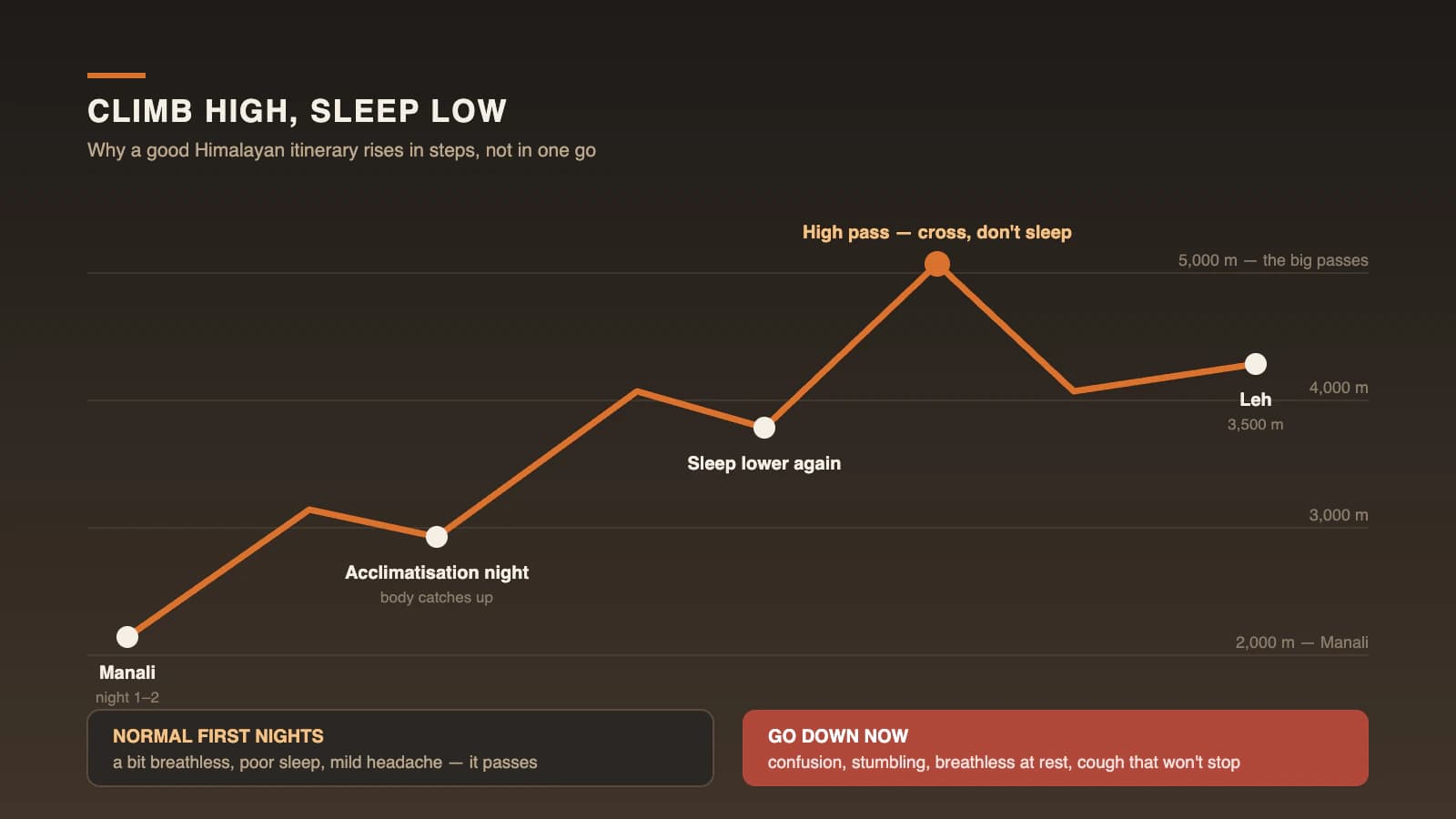
What's going on. Above about 2,500 metres there's less oxygen in every breath. Your body adjusts by breathing faster, working the heart harder, and making more red blood cells over a few days. Altitude sickness is what happens when you climb faster than your body can keep up.
Symptoms usually turn up 6 to 12 hours after you arrive at height. Headache is the main one, plus at least one of nausea, tiredness, dizziness or bad sleep. Mild altitude sickness is common and isn't dangerous by itself. It's a signal to stop going up, not to grit your teeth and push on.
The signs that mean go down now, no argument: stumbling or losing coordination as if drunk, confusion or acting strangely, breathlessness while resting, a cough that won't stop, or extreme exhaustion. These point to fluid on the brain or lungs, both of which can kill, and descending is the treatment.
How we handle it. Our routes are planned around how fast you gain height, not just how far you ride. Mountain medicine guidance warns against climbing quickly above 3,500 metres and says to limit how much higher you go once you're up there. That's why a Manali to Leh itinerary includes acclimatisation nights instead of charging over the passes in one go, and why we sometimes sleep lower than the highest point of the day. Climb high, sleep low, as climbers have said for a century. Every trip carries oxygen, and our guides watch the group for early signs, including in the riders who aren't mentioning them.
What you can do. Drink far more water than feels necessary. Go easy on alcohol, especially the first two nights up high. Keep eating even when you don't fancy it. Don't treat your first day at altitude as a fitness test. And be honest with your guide about how you feel. The rider who hides a headache to avoid looking weak is the one who causes a problem later.
On Diamox, which some people take as a preventative: the evidence is mixed when you're ascending quickly, and it's a prescription drug with side effects. Talk to your doctor before you travel. Don't take medical advice from a tour company's website.
The good news, and it is good news: most riders on a sensibly paced route feel a bit breathless and sleep badly for a couple of nights, then feel fine. Ladakhi and Spitian families live their whole lives at these heights. Your body handles this better than you expect, as long as you give it time. Giving it time is exactly what a well-planned itinerary is for.
So, should you come?
Here's what we actually think, after years of running these roads.
Almost every worry on this page has the same answer. It's a real thing, it's a known thing, and it gets managed by planning rather than luck. Roads close, so we build in buffer days. Bikes break, so a mechanic and a spare bike ride with you. Altitude is real, so the route is built around it. The water isn't drinkable, so we carry water.
What none of that planning can do is create the thing you're coming for. The morning you come over a pass and the whole Himalaya opens up in front of you with nobody else on the road.
That part's still down to you. You just have to book the flight.
Ready to plan it?
11-Day Himalayas Motorcycle Tour — the classic Manali to Leh run, and the best first Himalayan trip
Ladakh Motorcycle Tour — 8 days from Leh, the high passes, Nubra and Pangong
Trans Himalayan Motorcycle Expedition — 23 days, the full traverse, for riders who want all of it
Spiti Valley 4x4 Self Drive Expedition — the same country with four wheels under you
Winter Spiti Self Drive Expedition — Spiti under snow, for people who want it hard and empty
Still got a question this page didn't answer? Ask us directly. A real person replies, usually within a day, and we'd far rather answer twenty questions before you book than have you turn up unprepared.